


One of the defining developments over the past year has been the emergence of agentic AI workloads, systems capable of executing tasks autonomously through toolchains and external applications. More recently, the past seven weeks have marked one of the most dramatic repricings in modern equity markets.
This is evident in the way the Philadelphia Semiconductor Index (SOX) has surged ~60% since March, reflecting an abrupt reassessment of artificial intelligence infrastructure and materially outpacing the broader equity market over the same period.
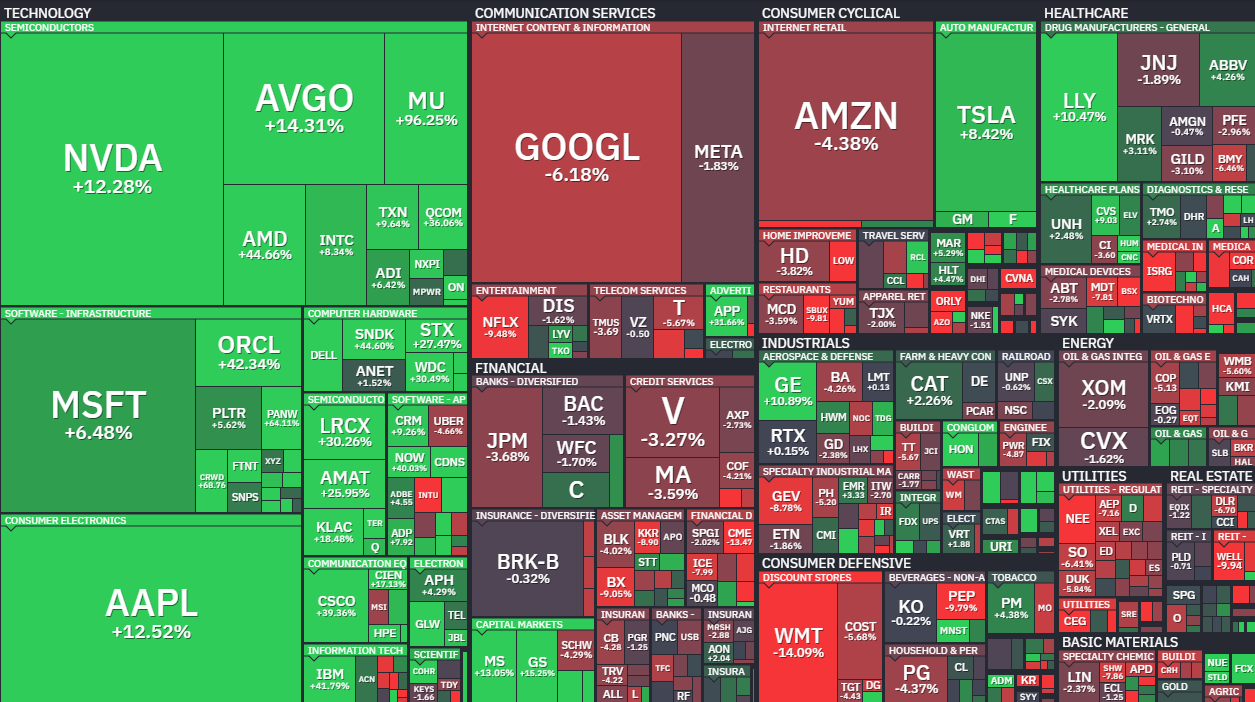
Visualising the capital rotation
Source: FINVIZ
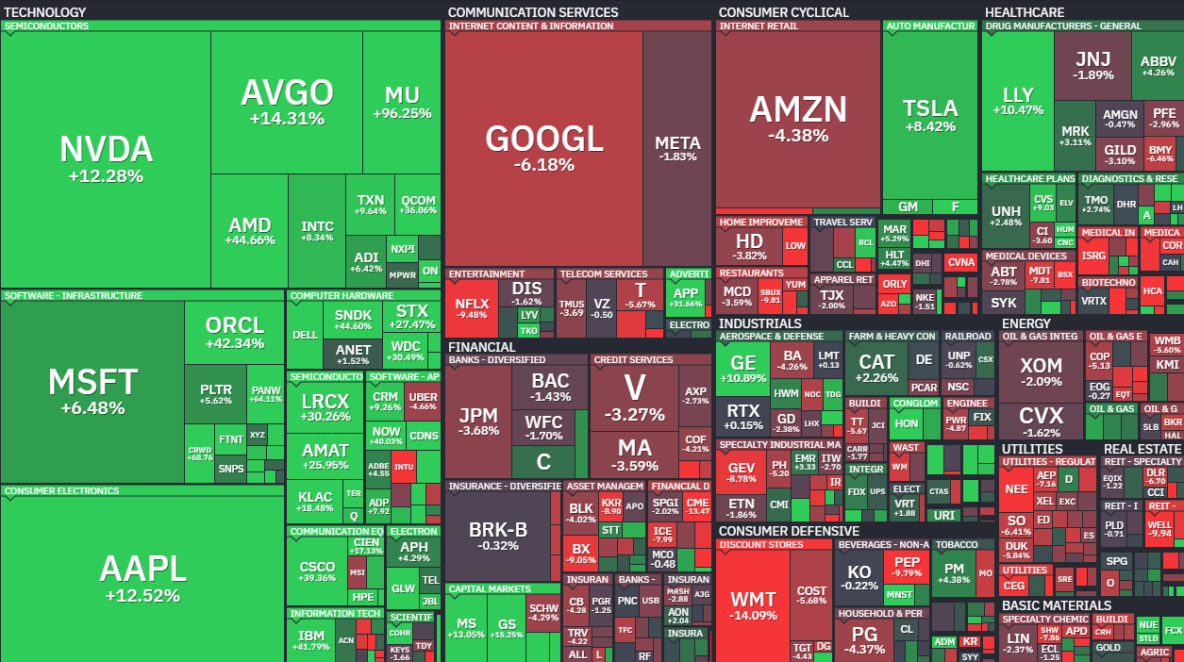
The sector heatmap highlights the dramatic valuation divergence between accelerating AI infrastructure/semiconductor blocks and the broader, macro-sensitive market.
One of the most significant share price moves came from Advanced Micro Devices (AMD), which rose +33% in May, supported by surging demand for datacenter CPUs and AI accelerators. AMD recently lifted its long-term server total addressable market estimate from US$60bn to US$120bn in a relatively short period, underscoring how quickly infrastructure assumptions are being revised as agentic AI architectures scale.
Not a traditional semiconductor cycle but a structural re-allocation
Loftus Peak is not constructed to track any single industry. Instead, it seeks exposure across multiple disruptive businesses, with valuation discipline as the primary constraint. Importantly, our largest exposures are presently in the tools for AI such as Graphic Processing Units (GPU’s) from Nvidia, (Tensor Processing Units) TPU’s from Broadcom. In this way, exposure is targeted to what we believe is the safest and most sought after of the components of the AI value chain.
Markets are moving faster than models
It is the scale and speed of the move in semiconductor company share prices that has made the sector a dominant driver of market attention.
At the start of the period, markets were still influenced by the so-called “HALO” trade – Heavy Assets, Low Obsolescence. Industries requiring infrastructure and industrial networks like power and utility systems, transportation and freight, communications infrastructure, energy logistics and long cycle facilities that support the physical economy were favoured. These were perceived as resilient in an inflationary environment.
As oil prices spiked and geopolitical tensions intensified, the fragility of that assumption became more apparent. Rising input costs and macro sensitivity began to erode the perceived defensiveness of these exposures.
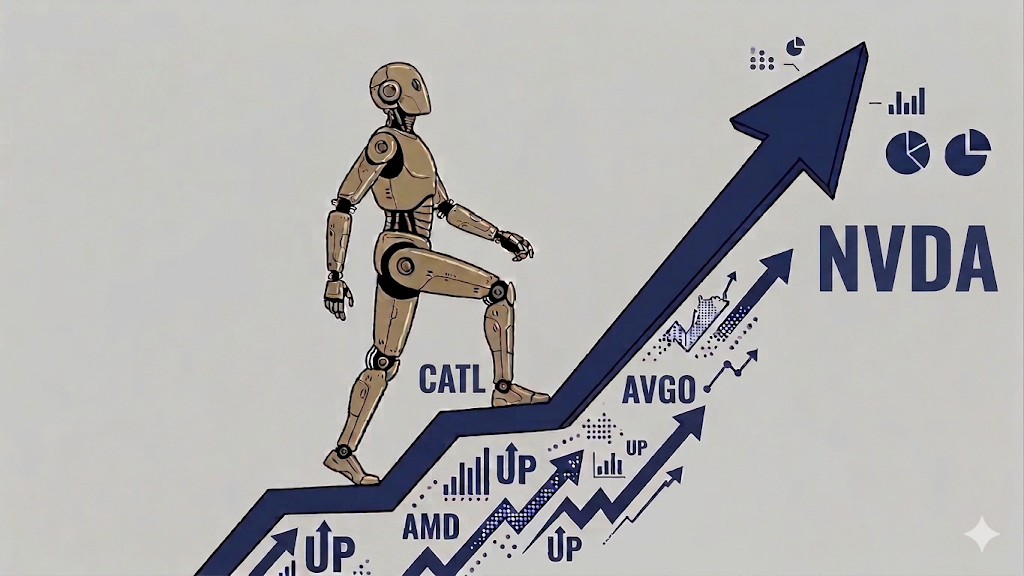
Capital rotated decisively back into secular technology solutions, particularly AI infrastructure, semiconductors and digital platforms, where growth is increasingly driven by compute intensity rather than macro conditions.
In a world of accelerating AI infrastructure demand, capital favoured speed, scalability, and software-driven leverage over physical asset stability.
Source: Gemini
Memory markets and the return of scarcity pricing
One of the most striking developments has been the repricing of memory, as well as the central processing unit (CPU) which only a short time ago was not considered part of the sweet spot for AI. It is this development that led to a 5-fold increase in the stock price of Intel, until recently considered a basket case.
Similarly Dynamic Random Access Memory (DRAM) and related components have tightened materially as AI data pipelines expanded across training, inference and storage layers. Suppliers including Samsung, Micron and SK Hynix have moved from cyclical exposure toward structurally higher utilisation, with pricing power emerging in segments historically treated as commoditised.
What was once viewed as a classic supply-driven semiconductor cycle is increasingly being reshaped by AI-driven demand shocks. Scarcity is no longer confined to leading-edge chips, it is spreading across the entire compute stack.
Electrification as industrial competition
Meanwhile, Loftus Peak has been investing much more broadly than just AI. Contemporary Amperex Technology Co. Limited (CATL), the largest battery company in the world, based in China, increased +27% in May, reflecting continued strength in global electrification trends.
The energy transition is increasingly being defined not as a linear adoption curve, but as a global manufacturing and scale competition. Battery technology, supply chain integration, and production efficiency are now the key determinants of competitive positioning.
This is particularly evident in electric vehicles and grid storage systems, where scale advantages compound over time and reshape industry structure.
As markets continue to re-rate structural growth assets, discipline remains essential. Long-term narratives in semiconductors and AI can persist for extended periods, but only when supported by execution, earnings delivery, and the price paid at entry. Care must also be taken to diversify, with portfolios we manage active in China, streaming, life sciences and EV’s.
Share this Post