



The launch of ChatGPT in November 2022 heralded a step-change in the application of technology-disrupting businesses globally. From its inception in 2014, Loftus Peak has identified companies driving the forces of disruption and built portfolios to deliver returns to investors.
Artificial intelligence is in the early stage of a powerful take-up that we expect will continue to drive disruption for years to come. Importantly, however, progress along this path will not be even or linear.
 Source: Unsplash; AI assistants have moved from novelty to everyday tool since ChatGPT’s 2022 launch.
Market volatility increased after the Google US$80b raising in June
The reality of this uneven path became apparent as the investment climate for AI and semiconductors shifted negatively and abruptly in June, just after Alphabet (Google) announced a surprise US$80b equity raising (its first since a US$4b issue just after listing 22 years ago). To put this into perspective, Alphabet will this year generate more than US$170 billion in annual operating cashflow. It holds one of the strongest balance sheets in corporate America. But its free cashflow will this year turn negative for the first time since that listing.
In the year prior to Google’s June announcement, AI investment was defined by explosive semiconductor share price gains, especially memory players such as Micron and SK Hynix, but also AMD and Marvell, which significantly outperformed software companies, thus marking a decisive shift toward these hardware names.
The question is: have things changed in light of the emerging capital intensity of AI? The hyperscalers – Google, but also Microsoft and Amazon – are the key players here. These companies in essence resell the large language models of the model makers Anthropic and OpenAI, as well as a dozen others including China’s cut-price players DeepSeek and new arrival Moonshot’s Kimi K3.
The AI players hit the bond markets for loans
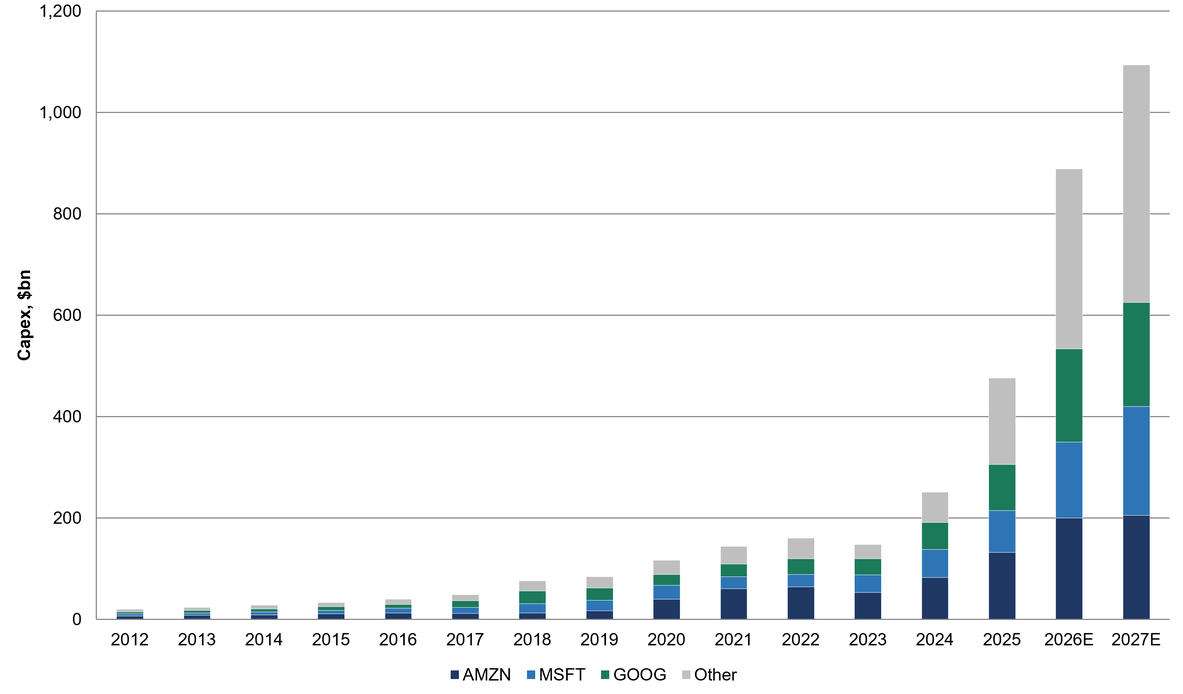 Source: Company Data, Evercore ISI Research, FactSet.
It is AI’s success penetrating business, education, law, coding and the like, that has pushed the hyperscalers to significantly expand their capital expenditure. The use of the term ‘significantly expand’ is not hyperbole. By 2027 collective capex for Microsoft, Amazon and Alphabet are expected to have more than trebled from the 2024 level of ~US$200b. And just as importantly, there has been no talk of when the capex demands would cease. The outcome of this is the expectation that the big three will go from significant net cash positions to unknown net debt positions, with the bond market expected to supply the credit. The Wall St Journal on 12 July summed it up this way:
“Over the past several weeks, the investment-grade corporate bond market has struggled to absorb a combined $50 billion of bond issuance* from Nvidia and Amazon. That marks a shift from earlier in the year, when investors were generally happy to hand money to AI hyperscalers by any possible means. While Nvidia and SpaceX were able to borrow at reasonably low interest rates, their newly issued bonds quickly slumped in the secondary market, disappointing investors who often like to flip such bonds. Amazon, meanwhile, had to pay unusually steep rates by its standards to complete its debt sale, reflecting investors’ newfound caution.”
“Wall Street is sending a message to tech companies engaged in a historic borrowing spree to fund investments in artificial-intelligence infrastructure: for pity’s sake, please slow down.”
*Excludes the Spacex US$25b which was included in the article.
Reflecting these concerns, the Philadelphia Semiconductor index, the SOX, entered bear market territory on 17th of July with a >20% fall since its June high.
How Loftus Peak handles it
Some of this is hyperventilating by players eager to talk their “AI-is-a-bubble” books. To provide counterpoint, investors who stayed out of the AI and semiconductor names which make up that index missed out on a +104% gain in the 12 months to Thursday 23 July, even including the correction of the past two months. Since the beginning of January 2023 to the end of June 2026 – broadly the period during which AI emerged as a global force, the Loftus Peak Global Disruption Active ETF has moved from a unit price of $2.31 to $5.93 – and this is after paying out 82.33 cents per unit in distributions comprising 33.33 cents in FY25 and 49.00 cents in FY26.
Portfolios managed by Loftus Peak are down a few percent in the month to date, but closed up +4.2% for the month of June. For the financial year ending 30 June 2026 the Fund was up +20.3% net-of-fees, with +2.7% outperformance, while the return since inception (November 2016) was +21.3% per annum net-of-fees, with outperformance of +7.4% per annum.
It is worth reiterating how the Fund is managed.
On the face of it, Loftus Peak’s global equity strategy, with its concentrated portfolio of around 30 stocks and an apparently narrow industry exposure to Information Technology and Communication Services, is risky. However, “blessings come in disguise”. Here is why.
The Loftus Peak approach to investing in disruption has delivered a ten-year track record that demonstrates that this deliberate concentration in companies driving change has extracted outperformance across most global industries.
By identifying disruptive global leaders early and rejecting speculative “moon shots” through a strict valuation framework, the strategy has successfully outpaced the broad-based MSCI All Countries World Index in Australian dollars.
Although the portfolio is subject to short-term drawdowns, such as the 2022 interest rate sell-off and early 2025 trade policy volatility – these declines have historically been recovered within reasonable time (i.e. typically less than six months).
Ultimately, for investors adhering to the recommended three-to-five-year horizon, the Loftus Peak Global Disruption Active ETF’s since inception Information Ratio of 0.64 proves that its calculated volatility is rewarded by risk-adjusted excess returns.
How does Loftus Peak manage risk?
Loftus Peak does not rely on a hope that one of a group of high-risk investments succeeds; the “moon shot”. Rather, the manager favours higher weights in companies in which there is higher confidence of meeting target valuations. Part of this is the focus on strong cash flows, low debt and robust balance sheets to mitigate risk.
To illustrate, Loftus Peak did not take a position in the highly publicised SpaceX IPO. SpaceX failed to meet Loftus Peak’s strict valuation criteria, in which higher hurdle rates of return are required for companies with relatively high risk.
What about portfolio concentration?
Portfolio concentration enables outperformance. The larger the number of holdings the greater the likelihood that performance will be index-like. The role of active management is not to mimic the index. To beat the index, don’t mimic its composition.
Investors who invest over the recommended investment horizon of three to five years have been rewarded with investment returns that have compensated for volatility.
What about industry concentration?
Presently, Loftus Peak is actively investing across more than 70% of the MSCI All Countries World Index (though as noted, not at index weights).
While portfolio investments are classified in six of the eleven MSCI All Countries World Index GICS (Global Industry Classification Standard) sectors, in reality portfolio companies are challenging incumbents in most global industries. For example, while not invested in Energy as defined by GICS, Loftus Peak has a material exposure to batteries for motor vehicles, energy storage systems and other fast-growing uses.
Rather than aiming to track global sharemarkets, the investment team seeks to identify those companies that are benefiting from disruption and that meet strict valuation criteria. These are the companies that Loftus Peak expects to dominate global industries in the future and that are included in Loftus Peak Funds.
Share this Post